Selected articles, obituaries, profiles, and references documenting the life and work of REX. Full text displayed where available.
Obituaries & Remembrances
The Tom of Finland Foundation announced the passing of legendary artist REX (American, 1947-2024).
REX was known for his meticulous pen-and-ink drawings depicting homoerotic subject matter, created over five decades. He began his work in the 1960s and lived in Amsterdam, where he developed a significant international reputation despite facing censorship and exclusion from the American art establishment.
REX's work was considered controversial and "too hot to handle" by mainstream American institutions. He lived as a recluse and cult figure, gaining recognition primarily through underground channels — first through pirated prints, later via the internet. His detailed pointillist renderings depicted scenes from leather culture and fetish communities.
The Foundation honored REX with inclusion in their Artist Hall of Fame. He had donated original works to the Tom of Finland Foundation's permanent collection, including "Leather Bar" (1978), described as "the earliest original REX in the artist's collection."
S.R. Sharp (2024) reflected: "Artists continue to illuminate the world with what they created so their light will forever fill the darkness."
REX, like Tom of Finland, refused to compromise artistic freedom for societal approval, remaining committed to uncensored expression throughout his career.
Source: tomoffinland.org
"This contemporary of Tom of Finland was as reclusive as he was sex-positive."
Full text behind paywall. Source: out.com
REX, a pioneering illustrator who depicted the S&M and fetish communities of San Francisco and New York during the 1970s-80s, passed away in late March in Amsterdam. He was approximately 76 or 77 years old, born around 1947.
The artist worked in pen and ink using pointillism techniques to create explicit black-and-white imagery of gay subculture in underground venues. His work appeared on pulp novel covers and in establishments like The Mineshaft in New York City.
REX ceased producing work when the AIDS crisis emerged in 1981. He opened a New York gallery in 1992 before eventually relocating to San Francisco.
Bob Mizer Foundation historian Trent Dunphy recalled meeting REX in 1980 at The Magazine store, noting: "He was a great talker" and describing how REX reacted to criticism of his work by stating, "That's the point!"
The artist was famously private about his personal life and refused photography. According to Dunphy, publisher Benedikt Taschen attempted to photograph REX, who immediately objected.
REX maintained a studio in The Magazine building, which is now home to the Bob Mizer Foundation. His workspace was decorated entirely in black.
In later years, REX became disillusioned with American culture, viewing it as increasingly puritanical regarding artistic freedom. He eventually relocated to Europe to work more freely.
Dunphy remembered REX's perspective on censorship: "In order for something to be pornography, it has to be forbidden by society."
Source: bobmizer.org
Copyrighted material — Jack Fritscher, Ph.D. & Mark Hemry. Full text archived locally for editorial review.
Commemorates REX (REX West), who passed away in Amsterdam in March 2024 at age 80. REX was a pointillist artist whose distinctive style became iconic in gay culture, comparable to Tom of Finland and Robert Mapplethorpe. He designed famous Mineshaft bar posters and merchandise. Excerpted from Fritscher's forthcoming book, Inventing the Gay Gaze.
Source: jackfritscher.com
Features & Profiles
Copyrighted material — Jack Fritscher, Ph.D. & Mark Hemry. Full text (5,424 words) archived locally for editorial review.
The seminal profile of REX. Fritscher calls him "the T. S. Eliot of graphic sex" and writes: "No artist scares guys the way Rex's work scares guys." REX is described as "an artist of the natural" and "the Id," creating work that confronts viewers with uncomfortable truths about desire. Discusses Rex's pointillist Rapidograph technique, his RexWerk gallery on Hallam Mews in San Francisco's South of Market, and the Paladin File portfolio series.
Source: jackfritscher.com
Copyrighted material — Jack Fritscher, Ph.D. & Mark Hemry. Full text (881 words) archived locally for editorial review.
Feature article positioning REX's work alongside and distinct from Tom of Finland and Etienne: "Rex expresses the psyche of leather culture far deeper than Arnett, the Hun, Domino, Etienne, Martin of Holland, and Tom of Finland. Those artists are each singular and great and safely gay. But REX is distinguished, because he goes beyond gay." Describes his subjects as "hairy, often clipped and shaved, muscular tattooed men" and characterizes REX as "basically a ritual, religious artist sanctifying the profane and the depraved."
Source: jackfritscher.com
REX, also known as REX, is a pseudonymous American artist and illustrator whose work is closely intertwined with the homosexual fetish art scene of 1970s and 1980s New York and San Francisco. Renowned for his distinct style, REX has deliberately maintained anonymity, eschewing photographs and personal discussions.
His drawings exerted significant influence on gay culture, notably through iconic graphics designed for renowned nightclubs like the Mineshaft, as well as impacting fellow artists such as Robert Mapplethorpe. Despite widespread censorship, REX remains enigmatic, asserting that his drawings fundamentally shaped his identity and that alternative "truths" are nonexistent.
His artistic journey was profoundly shaped by a chance encounter with a likely bootleg magazine featuring the works of Tom of Finland, an event he claimed "irrevocably changed his life." Quickly establishing himself with his unique black-and-white pen-and-ink style, REX became synonymous with an emerging S&M graphic aesthetic, alongside luminaries like Dom Orejudos (aka Etienne and Stephen), Steve Masters ('Mike' Miksche), and Luger (Jim French).
Operating as a freelance artist, REX initially found work illustrating a series of Rough Trade pulp books in 1972, characterised by 12 images per story. He also undertook poster commissions for various leather shops and gay bars across the United States, with his most notable pieces crafted for the Mineshaft nightclub. These posters and T-shirts, numbering in the tens of thousands, adorned the club during its 13-year tenure and even featured prominently in the film Cruising.
Additional commissions included the creation of a poster for the Pleasure Chest sex boutique in 1976, which subsequently led to his artwork gracing early covers of Drummer magazine in 1977 and advertisements for the poppers brand BOLT in 1980.
Source: 4me4you.org
Recognition & Exhibitions
REX is without question one of the most influential artists on the visual representations of gay male kink and leather in the post-Stonewall era —the period of dramatic institutional expansion, unapologetic self-affirmation, and exhilarating exploration that the AIDS epidemic will bring to an abrupt halt.
Put differently: after the generation of artists of the era of “classic leather” — Tom of Finland, of course, and Dom Orejudos aka Étienne, but also, often forgotten now though no less influential then: Steve Masters aka Mike Miksche, George Quaintance, or Chuck Arnett — he is part of the group of artists who will define he iconography of what might be termed “the golden age of leather” — with people like Bill Ward or Martin of Holland as well as The Hun or Al Shapiro.
He may well, in fact, be
the
most prominent of all.
In unison with his generation, in his drawings, REX celebrates not just masculinity, leather, uniforms, rough sex and big dicks, but also — overtly, unapologetically — the joys of orgies and bathhouses, sexual exploration, and extreme, wild and kinky sex. Unwilling to sanitize kink to make it look harmless and acceptable, he often throws into sharp relief the fantasies and fetishes most would rather keep untold — perhaps because he remembers the great lesson of the Stonewall generation: that the path toward de-stigmatization starts with naming.
Present everywhere
For REX’s work is one with the movement for kink affirmation. Most directly, his drawings are inseparable from the burgeoning of leather institutions in the late 1970s and early 1980s. His name may not have been known by the public at large at the time, but his drawings were.
Starting in 1977, REX contributed very regularly to
Drummer
and, through the magazine, his work was noticed and admired by kinky men on both sides of the Atlantic (see the contribution by Ad Shuring below). In San Francisco, as Gayle Rubin recalls below, his art was used in the advertising of many key leather institutions, and they immediately gained an iconic status as symbols of the kinky visibility of the Folsom neighborhood. Case in point: in 1980, a bakery in South of Market was advertising in their window a cake with the “Taste of Leather” design in icing. To which REX reacted jokingly: “You really know you’ve arrived when you see your art work copied on a cake!”(
Drummer
, 37, p. 64).
REX poster for the Mineshaft
But it is through his association with the Mineshaft in New York City — without question the most notorious and legendary SM sex club in the world at the time and perhaps even since — that REX’s work gained the most visibility. In 1976, manager Wally Wallace commissioned him to design a poster for the club. A hot, muscular, hairy man wearing a miner’s cap and holding the club’s logo became its symbol. The poster was an instant classic. It immediately became a collector that patrons wanted to own. REX was now the House artist for the Mineshaft and thousands of copies were printed. A T-shirt followed. Over the years, three posters and T-shirts were designed by REX for the Mineshaft. They were sold exclusively at the club. And they sold in the tens of thousands, bought by people from all over the world.
The legend of the Mineshaft is inseparable from these three drawings. In 1978, throughout the
video-clip of Queen’s “Don’t Stop Me Now
,” a song that combines images of ecstatic fun, speed and limitless power, Freddie Mercury is wearing one of those Mineshaft T-shirts. Throughout the years, the video-clip will be seen by millions, if not billions, over the world. A couple years later, in the infamous
Cruising
, the posters also appear in the decors built to replicate the atmosphere of the Mineshaft.
Obscure beginnings
The popularity and visibility of REX’s drawings stand in sharp contrast with the humble and obscure beginnings of his career. REX was born in 1942, and was abandoned at birth. He grew up an adopted kid in the rural Northeast. Sometime in his teens, he fled from what seems to have been an extremely oppressive milieu and, in the mid- to late-1950s, the smalltown boy had turned into a runaway kid in the streets of New York City. There, a famous fashion designer noticed him, took him to his Manhattan penthouse, and kept him for 3 years: during that time, he paid for his education at the Cartoonists and Illustrators School which had recently been renamed School of Visual Arts, and sent him to London and Paris to start a career in fashion illustration and commercial art.
In Europe, thanks to the introduction of his benefactor who believed in his talent, REX was introduced in the luxurious world of fashion designers, models, publishers, and fancy cocktail parties. He did not take to it. Instead, he developed an abiding hatred for a world he viewed as artifice, superficiality, and pure appearances. He did, however, enjoy spending long hours walking through European museums. He had a passion for the Italian, 16th century painter, Caravaggio.
While he loathed the glossy world of fashion, REX reveled in the gutter. In Paris, he discovered the
pissotières
, the public urinals, haunted by anonymous men who, without regard for social status, looks, sexual orientations, or other hierarchies, worshipped the same god. Is that the source of his fetish for uncut dicks? The story does not tell.... In any case, he experienced returning to the streets of New York City as a liberation. He held several jobs for the MAFIA, including boxing club manager.
At some point, in a magazine shop on 8th street, he had the decisive encounter of his life: the drawings of Tom of Finland jumped at him. He never recovered.
Now, REX had found his calling. A few months later, he returned to the same shop to show some art of his own. The owner sent him to a publisher, an Italian man who immediately knew he had the new Tom of Finland in front of him. But first thing first: he needed a name. The young man looked around him. A film was on the desk with a three-letter title. REX was born.
He started doing illustrations for the Rough Trade series. Most importantly, in October 1970, he found The Eagle. The energy was not unlike what he had liked in the t-rooms of Paris and London: men, workers, bikers, sweaty, dirty, masculine, rough, unconcerned with good manners, bonding in an exclusively male space. Outcasts, if not outlaws.
One day that he was working on a sketch there, somebody recognized the illustrator from the Rough Trade Series. He was asked to help with the newsletter of a biker’s club. One thing led to another.
The rest is history.
The house is on fire
July 1, 1981: REX opens his fist gallery, Rexwerk, on Hallam Street, in the Folsom neighborhood of San Francisco. The block where he lives is home to many leathermen, including leather photographer Mark. I. Chester. It once housed the Barracks, a famous bathhouse that closed in 1976 and was then being converted into a hotel.
A month earlier, on June 5, 1981, in its
Morbidity and Mortality Weekly Report
, the CDC reported the first five cases of what would soon become the HIV/AIDS epidemic.
On July 10, nine days after the gallery’s opening, a construction worker started a fire from the former Barracks. 27 buildings were engulfed. The gallery was in ashes. So were also all of REX’s originals.
The fire was not caused by leather people. Leather people were among its victims. And they were further victimized by the hysteria unleashed by the fire as rescuers, media, and local politicians were going through the rubble, exposing their homes and vilifying their lives, claiming to smell “burning meat,” expecting to find the remains of chained subs and slaves (which, obviously, were never found).
That event, combined with the early signs of the HIV epidemic, marked the beginning of a dark period in REX’s life. His work continued to appear in various outlets for a while; he did several posters for the Saint, in New York City, but he soon stopped publishing for several years.
In the early 1990s, REX returned to New York City and opened The Secret Museum, a “by appointment only” private gallery. Another tragedy would bring this experience to a close: 9/11. By 2002, he had moved back to San Francisco. Eventually, disillusioned about what he perceived as increased political correctness and a suffocating atmosphere of censorship, he moved to Amsterdam in 2010. He still resides there today.
Visible nowhere
Trying to write REX’s life beyond this very broad sketch is an impossible task. There is a lot that is not known. His birth name is not known, nor is his last name. There is no photograph of him we could attach to this tribute: for over 50 years now, REX has consistently refused to have his photograph taken. He himself discourages any attempt to find out more. Some passages allude to a founding moment that started him as an illustrator, but REX won’t say anything about it.
The reasons are unclear. Early on, it may have been a way to avoid legal persecution for his works. It may also be a remnant of the code of silence from the time when he worked for the MAFIA. It may also have worked to add an aura of mystery around his works. Or it may simply a result of an extreme shyness, a feature his friends often mention.
“No other truths out there”
Whatever its reasons, the secrecy is a hallmark of REX’s career. His closest friends point to Wikipedia as the most reliable source. There, he is quoted as saying that his drawings “defined who I became” and that there are “no other ‘truths’ out there.”
For that reason, instead of writing the impossible biography REX never wanted us to read, in order to honor him and his legacy, we take him at his word and let the work speak for itself. Some of the writers below have known REX for many years; others have only ever known his work. All share an abiding admiration and respect for this outstanding artist. We asked them to select a drawing of REX that has a particular meaning for them, and to write a short text about it to mark his induction into the Leather Hall of Fame.
Rostom Mesli
Managing Director & Editor
Folsom Man 1978
REX and the iconography of San Francisco Leather
REX created much of the look of San Francisco leather, especially during its heyday in the long 1970s. San Francisco leather bars and bike clubs had formed in the early 1960s. But from the late 1960s through the early 1980s, leather institutions proliferated and became a visible presence in the South of Market neighborhood, a formerly industrial and working-class residential district that was being emptied out by deindustrialization, suburbanization, and projects of urban renewal. Leather bars, sex clubs, retail shops, and bathhouses were able to take root in vacated tenements, small scale factories, and neighborhood bars and lunchrooms. Moreover, once
Drummer
relocated from Los Angeles to San Francisco in 1977, the local leather scene was featured in leather’s major national publication.
REX’s art was a major visual feature of this burgeoning community. He did illustrations for the catalog of the earliest leather shop, A Taste of Leather, and provided the imagery for the posters of several major bars. These included the Black and Blue (memorialized in Frances Fitzgerald’s
Cities on a Hill
), the Brig (for many years the premiere local S&M bar), and later, the Lone Star Saloon (the first bar to focus on what was then the emerging bear subculture). REX’s work was also often featured in
Drummer
itself.
But the most iconic image was a poster for A Taste of Leather: it depicted a man in full head-to toe leather regalia, from his biker cap to his heavy engineer boots. His shirtless, muscular, and hirsute torso was framed by the classic motorcycle jacket and transected by a Sam Browne strap, drawing attention to his belt and leather chaps. These framed a bulging basket, to which further notice was emphasized by the placement of his hands, with one finger pointing at his crotch.
But the aspect of this image that makes it so utterly representative of San Francisco leather during this era is that he is leaning, nonchalantly, against a street sign that reads: Folsom. Folsom Street was the main boulevard of this leather occupation, so much that the leather area was often just referred to as “the Folsom.” It had many nicknames, including the Miracle Mile, but that too referred to Folsom Street. Although there were leather bars and shops and sex clubs scattered around the neighborhood, most were either along Folsom Street or clustered nearby.
If the Chuck Arnett mural in the Tool Box symbolized SF leather in the early 1960s, this poster by REX was the archetypical image of SF leather in the late 1970s, the period of its maximum expansion, visibility, and association with a particular neighborhood and a special street in the geography of the city.
Gayle Rubin
Dog Food
, 1981
Around 1988, The San Francisco Arts Commission Gallery organized a show with this premise: A prominent Bay Area artist would pick another artist, who would then pick another artist, who would then pick another artist, and then all four would show one work at the gallery in Civic Center, across from City Hall. The performance and installation artist Tony Labat picked me, and then I picked REX, an artist whose work I loved and who was a star of the Gay Leather scene, but was, in my opinion, criminally ignored by the general Bay Area art world. REX in turn picked Mark I. Chester, another important Bay Area artist whose name would not have registered for most of the Art Commission’s patrons.
Each of us was free to select which work we wanted to represent us in the show and while I have no memory of what I included, I’m pretty sure that this was REX’s choice. If not this, he might have chosen its counterpart, where the dog and the greaser are attending to a steel toed boot while a discarded jockstrap oozes a load onto the ground. In any event the picture brought the delights of one of San Francisco’s most important communities into the center of its official civic life. The magic of REX’s work is that it uses the precision of his compositions and the tenderness of his stippling to render his desires iconic and fascinating. The talent ensures that we can’t look away, and once our gaze is held we can revel in the details that he weaves into each picture. His work is hot but never overheated, and he can make a biker piss orgy seem like the most elegant gathering on the planet.
The opening of the Arts Commission show was the first and only time we’ve ever met, but I’m grateful for all his drawings have taught me in the years before and since.
Nayland Blake
Icons
Cover, 1977
I first discovered REX on a play date. I was at a fist buddy’s house and was looking through the books on his coffee table while he was finishing cleaning out. There it was.
Icons: Drawings by REX
. A dirty, raunchy collection of black and white images that immediately piqued my interest. As I skimmed through the pages, I saw men smoking, big hairy muscle asses, young boys, daddies, and dogs... each page with the name REX printed in the corner. The boy came out of the shower, and I unfortunately had to put the book down. But the name REX stayed with me, and his images were immediately burned into my mind.
I started to notice more and more of REX’s work around the city: in bars, in homes, and at Auto Erotica, a local store I frequent in the Castro that sells, as its name denotes, erotic art. Despite researching REX online, I was never able to find that book or much of his work available for sale. Perhaps it was out of print. Was REX a name, a set of initials, an acronym, or something else? I discovered that REX was a pseudonym chosen because it was non-specific and non-traceable by the police in a time where gay art at of this nature was criminalized. The sex was not legal; the art depicting it was not either. Despite laws and cultural attitudes changing, REX chose to remain in the background to let his art speak for itself, which to me it most certainly does.
At Auto Erotica, I encountered the largest collection of REXwerk that I have ever seen in person. It was here that I started to collect different pieces of his art: a couple postcards, a handful of prints, and a poster that REX designed for The Caldron, a local San Francisco fisting club. I also found one of my favorite REX prints to date. The print features a jock-strapped man standing over a boy pissing down his neck and back. The man’s ass is covered in fur and his dick is uncut and leaking. You can practically smell the raunch through the image. As someone that is incredibly scent motivated, I find REX’s work to be particularly arousing. In the print, you don’t see either the boy or the man’s face. The only identifying feature of the boy is a tattoo of a bat, a feature which I also identify with.
I love the raunchiness and the exhibitionism. Put simply, REX’s images get my dick hard and my hormone monster raging. His decision to use different shades of black masterfully mirrors the darkness in the sexual scenes he depicts. There is a sense of moral ambiguity inherent in most of his work. Are these scenes depicted consensual? Are these men father and son? Wow, that’s a big dog!
I love REX’s work, enough to want to get it tattooed. I once tracked his email down and reached out, but he has since stopped taking commissions. I still keep an eye out for his books, hoping to find some for his work to add to my collection.
Stephan Ferris
Arm Bum Town
, 1987
Riddle of the Sphinx
, 1987
The erotic work of REX stands out to me because it scours the secret world of raunchy man-to-man sex. His characters exist in a film-noir setting that is unashamedly raunchy, with that particular kind of urgency that other well-known artists simply couldn’t capture.
One of the things I noticed in some of his works is that there is an onlooker, a voyeur. And in the instance of “Arm Bum Town”, the voyeur is more like a commentator. One could speculate all manner of things about the role of the voyeur, and that, of course is part of the fun in such a piece.
Robert Roberts, aka Mad Dog, tattoo artist,
author of
Mad Dogs and Queer Tattoos: Tattooing the San Francisco Queer Revolution
.
Trash Man, 1982
Father and Son Tattoo ©Chuck Conner
REX’s work is visceral and raw and frequently visualizes taboo kinks, and fringe interests rarely addressed in print. REX has been drawing queer theory before it had a name, and more importantly, REX works as a storyteller. Each illustration defines a facet of our kink culture, and REX chooses to tell it like it is, not how those outside the kink community would prefer to hear it. Fearless in his depictions, REX’s drawings showcase gay male sexuality without omitting the darker aspects of our hunger for more, our lust for the extreme.
The drawing
Trash men 11.30.1982
embodies a trifecta of taboos; grimy back alley sex, beastiality, and lust between two breeds of Alpha; man and dog. The image speaks to me on these obvious fronts but also carries profound meaning as a rite of passage. My chosen son and I wear mirror versions of the illustration as tattoos, expressing our pup play sex dynamic while showcasing our Father/son bond. As a subplot to REX’s original story, wearing his work tells the world we are “other,” outliers who dare to voice our desires as they come to us.
The ability to find our own stories in REX’s work distinguishes his drawings from all others. REX’s
work is beyond mere illustration or “dirty drawings.” It chronicles the depths of our kink culture, spoken without words, yet finds its power in the viewer’s resonance with seeing their fantasies made real.
Chuck Conner
Scorpio Boot Slave
, 1990
Like most young men, I masturbated a lot. I usually did it while looking at images and personal ads in
Drummer Magazine
. Yes, personal ads. Reaching an orgasm is mostly an exercise of the brain. I learned to allow my imagination free rein, and personal ads left more room to include the increasingly extreme, twisted and horrible details I needed to get off.
Photographs and drawings too often depicted something that ruled out something else that my head wanted. Once that happened, it was hard to climax looking at that image ever again.
For that reason, I treasure this drawing by REX. No photograph or work of art helped me shoot more reliably, and that compatibility never faded.
I was aroused by the power differential, so well depicted by the positions of the two men: his cock so close to my mouth, knowing the inevitability of him moving in even closer. I could feel the heavy neck and head bondage. My imagination had made that permanent keeping it in position for this perfectly entitled, masculine officer. I reveled in the joy and the anguish of being his property and victim. I could not help but love the cut of his uniform and the power of his black boots worn outside his trousers. I was proud that he held the crop as he did, knowing that he used it on me as often and as hard as needed, wanting him to use it to maximize his satisfaction.
But
the coup de grace
was on the floor. In almost all other similar pictures, the bottom’s arms and hands are also bound, or the bottom is touching the top’s legs or ass or balls, bringing him pleasure. For me, that bondage or that service would not
assure greater compliance or devotion. For me, this man is greater, and this art is more compelling.
REX left my hands free so I would willingly put them in the place where the officer would trap my fingers with his heavy, hard, unfeeling boots, guaranteeing and certifying our mutual arousal. REX knew this about me, and about others like me.
As the drawing shows, his cock proves his supremacy, and my cock confesses what he al- ready knows. In my head he moved closer, naturally, his boots crushing more of me, enabling even more loyal service.
Outside the drawing, as my actual right hand stroked my actual hard cock, there was no way to evade or deny who I was. REX showed the world what kind of man he had found in me. I was grateful to be locked here forever, and happy that my gratitude was unequivocal. With all this and more in mind, I reached one seismic orgasm after another, day after day, for years.
Thank you, REX, for drawing my portrait so well.
Bob Miller,
Founder & Executive Director of the Leather Hall of Fame
Trailways
, 1977
When REX was living in New York City, he had a boyfriend who owned a horse that was kept at a track stable in New Jersey. One day REX took a Trailways bus over to New Jersey to meet up with him. REX waited for his boyfriend in his truck while he tended to his horse. This is when REX envisioned this drawing.
Everything inside this 50s truck was real including the gun, the pack of Camels, the can of Budweiser, and REX’s Trailways ticket over the visor. The boyfriend appears through the windshield.
Clyde Wildes
This drawing takes me back to my college days, when I used to cruise the city park near my university. Of course, I never had a sublime hunk step on my hood with his giant dick hanging behind my windshield being the only part of him I could make out. There, instead, guys would leave their car in the parking lot and either walk up to your car, chat, and get into the passenger seat to suck you or take a walk into the bushes where I’d join them to get a blow job and give a fast fuck.
Yet how do I wish some hot hairy dude would have jumped up on my hood to jerk off while I was jerking off watching him... or, better yet: had done so while I was fucking in the bushes, only for me to find him on my hood as I was walking back to my car!
What throws this one over the edge for me is the guy to the side watching/being an audience to what’s happening: is he walking back to his truck and, in a twisted way, the intended audience for the hunk jerking? Or is the intended audience in the truck, which would then put the guy in the background in a position of voyeur, walking into a scene he was not supposed to see (as we, viewers of the drawing, all are) but in which he is nevertheless welcome? If he is in fact the owner of the truck, is he turned on by what he is seeing? At least amused? Or is he enraged and ready to grab the gun in the truck to teach the hunk a lesson?
That’s what I like most about REX – his way of putting you at the intersection of hot and dangerous, often without telling you for sure on which side you’ll end — perhaps because the two are inseparable? And his way of making you witness things you did not expect to see, you may not have wanted to see, and yet things that are unquestionably about you and that welcome you.
I’ve had many satisfying jack-off sessions to REX’s drawings - I’d like him to know that and I thank him for it.
Gary Keener
The Night Watch, 2015
I visited REX in Amsterdam in the Summer of 2019. After I admired this drawing, which is REX’s version of Rembrandt’s
The Night Watch
, REX took me to the basement darkroom of the
Cuckoo’s Nest bar
at Nieuwezijds Kolk 6, Amsterdam. This is where he envisioned the scene depicted in this drawing.
If you visit the darkroom, look around at the bottom of the stairs and perhaps you too will recognize this scene. Of the 13 faces in the drawing, which one is REX? He drew himself as one of the horny men in this scene.
Clyde Wildes
A remembrance by Ad Schuring
I cannot remember when I first got to see REX’s drawings, but I guess that must have been in the early 1980s, at an adult bookstore on Haarlemmerdijk. I used to go there and leaf through the mags (mostly without buying).
Drummer
was my favorite: not only because it explored the outer edges of kinks and made me feel at ease, confirming I was not alone and there was an abundance of pigfags out there; but also because it featured a bunch of brilliant illustrators and visionaries of that underworld. On the occasion that I did buy a copy, it was primarily for the drawings of REX and Bill Ward.
Bill Ward and REX worked in black ink. REX in particular had mastered a technique that allowed him to overcome the limitations of budget printing of those days. By painstakingly doing the shade-gradation himself with millions of tiny inkdots, he took out the need to raster the images, still emphasizing amazingly suggestive lit or dark spaces, and even more fantastic body, ass and cock shapes.
A few years later, I got to know the two main Dutch artists, Willem Kok (aka Dorus) and Martin of Holland, main illustrators of
Centurion
, the most extreme Dutch gay S&M magazine. I also got to know their friends Bastille, the Hun, Rick Castro, Axel, as they came to Amsterdam and exhibited at RoB and MrB. Willem Kok’s place became my Amsterdam pied-a-terre whenever I worked in Amsterdam. And that is how I started posing for him whenever he needed someone in an anatomically impossible position for a leather of fetish poster. I still feel the cramps. I would never have tried these poses on my own, but they felt surprisingly comfy when it all was done for art’s sake.
A submissive model was born!
Through Willem and Martin, I also met Durk Dehner. We both had the experience of being a model (he had been the muse of Tom of Finland), and we shared a passion for promoting queer artists. At one of the Tom Foundation’s art fairs I visited, I learned that REX was planning a move to Amsterdam and was asked if I could help him find his way through the city.
That was too good to be true: assist my porn-art hero, WOW !
REX and I immediately became friends and, as I had been asked, I helped him get settled and, over the years, worked with him when he had to appear at cultural events or in local media.
We had our share of intense conversations and passionate disagreements, but remained loyal to each other: keeping our friendship apart from any business and commercial entanglement had a lot to do with it.
Early on, REX asked to visit his own hero, the equally uncompromising scat pioneer Martin of Holland, then at the very end of his life. He managed to make it to den Haag just in time.
More fun was touring him around the Dutch countryside, on my motorcycle, showing Den Haag’s Parliament, our sea defences and, more importantly, our nude beaches, cruising areas, clubs and bars.
For his first months in Amsterdam he stayed at the Anco Hotel, a landmark of leather history. Posing for him there felt natural. As for the portrait, he set up a scene in one of our favorite darkrooms at Cuckoos’ Nest.
No longer for art’s sake; I was at home, immortalized by REX, slobbering cum and piss, deter- mined not to miss one drop; that felt just right!
Sadly, shortly after, REX felt his hand was losing its stability: he had to drop his pen and retire. The portraits of Jaques Zonne, coat-check/host guy of the Web Bar, and myself are probably his last drawings.
Although his work, notably for the Mineshaft and
Drummer
, was seen by millions (for example when Freddie Mercury wore a REX t-shirt) and made him one of the foremost visionaries of kink, he had firsthand experience of censorship and repression, starting his art career in NYC in the 1960s, a time when the city was largely under MAFIA rule. Two decades later, he lost everything he had: business, apartment, all his original drawings, in the 1981 Folsom street fire. The leather panic that ensued and further victimized the victims of the fire was another instance of wild bigotry that he experienced.
That probably helps explain why he has so consistently stayed out of the spotlight his work enjoyed. He is exceedingly weary of appearing in public: only very reluctantly did he accept to attend the recent exhibitions he had in Amsterdam, Berlin and Antwerp. He much prefers to just be approached through the contact form of his website than in person. The spotlight spooks him; he even asked me to accept the lifetime achievement award of the Tom of Finland Foundation on his behalf.
Adoring Eyes, 2015
That does not mean, however, that he is indifferent or not grateful. At the time, he did write an acceptance note that he asked Sharp and myself to read at the ceremony. His words remain just as relevant today, as he is inducted into the Leather Hall of fame:
“Against prejudice, violence, threats and bigotry we defiantly took pride in openly deipict- ing our counterculture lifestyles and rituals to the world a half-century ago. Mine was the first generation that came out of the closet to the art world, the decade before Stonewall.
We paid a heavy price in those early days for drawing dirty pictures as they were then called, sacrificing our lives, our health, our jobs, our families and homes for daring to depict “The Love That Dare Not Speak Its Name.”
Our art was burned and destroyed in raids by civil and postal authorities, condemned and spat upon by church and state, and especially despised by the art world itself for whom we were rude intruders, storming the gates of their conservative ivory towers.
Therefore, it is with great humility that I accept this award on behalf all those artists of my generation who did not survive our epic battle to give gay art the prominence it currently enjoys in the world today.
Thank you, REX”
Source: leatherhalloffame.com
I wish to thank the members of the Foundation for honoring me with this award.
I accept it for myself and on behalf of all the nameless and now forgotten gay artists of my generation who pioneered in making both the art world in particular and society in general, first become aware that an audience for such art existed.
Against prejudice, violence, and bigotry we took pride in openly displaying our lifestyles to the larger world a half-century ago.
Mine was the first generation that came out of the closet to the art world a decade "before" Stonewall.
We paid a heavy price in those early days for drawing dirty pictures as they were then called, sacrificing in many cases, our lives, jobs, familly ties and homes for daring to depict The Love That Dare Not Speak it's Name.
Our art was burned and destroyed in raids by police and postal authorities.
The work was condemned and spit upon by church and state, and especially by the legitimate art world for whom we were rude intruders storming the gates of their conservative ivory towers.
What we dared to depict of the naked male form were criminal acts back then and those of us who portrayed them, criminals.
So addressing you today in this Pantheon of Gay art that Durk Dehner has created from scratch, is for me coming full circle with our shared past which began 38 years ago.
I dare say Durk and I go back to the "very beginning" of our separate but similar journeys to form a cohesive American Gay art movement in the nineteen sixties.
Since day one and over the decades since, I have borne witness to his unrelenting dedication in raising public awareness of Gay art, first nationally and later internationally.
He achieved this incrementally step-by-step over the decades against overwhelming odds and intense hostility until finally bringing it to the wide acceptance Gay art now holds today.
Without Durk the art on these walls, the books on these shelves, infact this very building and the people gathered in it would not be here today were it not for his fierce determination in bringing his vision of a universal Gay aesthetic into reality.
Without his unstinting dedication the entire Gay liberation movement of the nineteen seventies would have lost a major cornerstone of its foundation and ongoing success.
I among many other artists exhibiting here today, and at all the previous ToFF art fairs, would not have had the opportunity to exhibit our work to a wider public without that dedication.
Therefore it is with great humility I accept this honor on behalf of all those fallen artists of my generation who fell in our epic battle to bring Gay art to the prominence it currently enjoys.
Thank you, REX
Source: tomoffinland.org
For the first time ever, Antwerps internationally recognized Leather & Fetish Pride at the Darklands festival showcases over 200 images from REXs incredible career in art. The majority of this art in this retrospective has never been allowed public exhibition due to government censorship and the scourge of political correctness.
To honor his 50th anniversary of producing iconic Homo-erotica for the Gay fetish world, Jeroen van Lievenoogen and his team have honored REX with the largest exhibition of his art ever held. Half of the exhibited art will be located in the REX Arena play area, which REX claims is, the place where it belongs. Still more work can be seen at the REX Bar and REX Stand, where art, catalogs, fine art prints, cards and posters offered for purchase.
The objective of
REXWORLD: Back to the Future
is to make the impossible possible: After a half century of creating iconic fetish art for the gay community, REX images have become ubiquitous around the world as anonymous art, that is endlessly copied and circulated on line without permission, payment or credit for decades now. Now in his vintage years, this much censored and ignored artist is to be honored with this rare European exhibit, which highlights five decades of his pioneering contribution to gay history.
The fact they have a hard-on when viewing this material makes them more likely to surrender themselves to these images. Yes, this is pornography sorry about that and its purpose is to excite and arose sexually to the point of orgasm. Whether you think you like it or not. After alcohol does its work, all moral or intellectual resistance to this work fades this work comes alive as youve never seen it before. Even for myself when viewing it stoned (Did I really draw this?). Sexual situations are its proper setting and purpose. And in this darkroom area” at Darklands these images being the only available soft light, people will be like sitting-ducks to the power of these images inescapable regardless of whether they think they like this stuff or not. Their libidos will decide the issue for them. The Darklands organizers seem very much on board but we should keep rubbing their nose in how spectacular this could be if, they are only daring enough to keep thinking outside the box in promoting this once-in-a-lifetime show for both: them and myself. I cant imagine, I will EVER top this presentation we are mounting. I can die a happy if poor man after this. And after all, this is about the future and the future is always about the unexpected.
-REX
Runs through 25th February
Whether you can attend, or not, please support the crowdfunding effort.
Source: tomoffinland.org
Academic
From Chapter 6, "Knights, Young Men, Boys" — excerpt on REX
schema in this project. If one admires the hypermasculine as that which dominates, then one contributes to that which dominates. But there are other possibilities.
As long as the hypermasculine is simply the development of natural capacities, it is justified easily along the quasi-moral, quasi-aesthetic lines mentioned above concerning various nonmoral or at least nonobligating goods (like health and knowledge). It should be noted, however, that these nonmoral goods are trumped by moral obligations and moral rights. The value of their development does not constitute a legitimate excusing condition for failing to carry out one's moral obligations and does not override legitimate claims of rights. For instance, although leather enhances the smell of males, the production of leather may itself be immoral as a violation of the rights of animals. In that case, the nonmoral interest in developing the masculine in this way must give way to the higher claim of rights.
The prospect for moral problems arising in the development of the hypermasculine will loom threateningly when the manly—the blend of male and masculine—alludes to and draws for its force on social tropes that are traditionally associated with domination over women or with the exclusion of women in ways that degrade them, either by denying them equal worth as persons or by prejudicially limiting their liberty. Such problems lour even when women do not appear in specific representations of the hypermasculine, as in fact they usually do not. Now, I would be the first to admit that hypermasculine gay culture is awash in images that are frequently used to promote the admiration of masculine domination and that even mentally fix this admiration through orgasmic inducements. And much of gay culture is at least problematic in the way it portrays power. Here fall Mapplethorpe's sexy photographs of black men sitting, posed and perched, on pedestals and George Dureau's sexy photographs of male nude cripples, midgets, and amputees. Do Mapplethorpe's photographs of nude black males parallel the cultural positioning of women as at once princesses and whores? Or do they instead send up that objectionable positioning while at the same time, in their severe formalism, deeply and authentically admire black men? Similarly, George Dureau's photographs may be read either as affirmations of the physically challenged as sexual agents or as depredations of them as one-man freak shows. What, for instance, is one to make of a photo of a gay-coded crippled midget in Nazi regalia posing and posed as though dreaming of the Hitler Youth? I think that there is no easy moral assessment here.
What I want to suggest generally, however, is that, when the gay hypermasculine appeals to objectionably stereotypical masculine tropes, it can and typically does do so in ways that undercut the tropes' possible uses in the oppression of women. The gay hypermasculine is not, on the one hand, the product of a trade in or over women's bodies. Nor, on the other hand, is the gay hypermasculine a flight from or an avoidance of the womanly. It does not get its charge, its sense of self, by distancing itself from women and from the derivative slur that gays are nellies, queens, inverts. Nor does it get its charge, its potency, through attempting to assimilate to the dominant culture as an effort to gain acceptance from that culture and thereby indirectly degrade women. All this can be so even though the gay hypermasculine does in fact exclude women—from such private and discretionary spheres as sex, romance, marriage, and religion. The architecture, the temple, of the hypermasculine is not the Bohemia Club, the Cosmos Club, the New York Athletic Club—Clubland generally—but the gay bathhouse and leather bar. Let us look at hypermasculine men first by ones, then by twos and more, to see my point. My examples are drawn chiefly from the gay erotic draftsman Tom of Finland and REX.
MEN ALONE STIR MY IMAGINATION
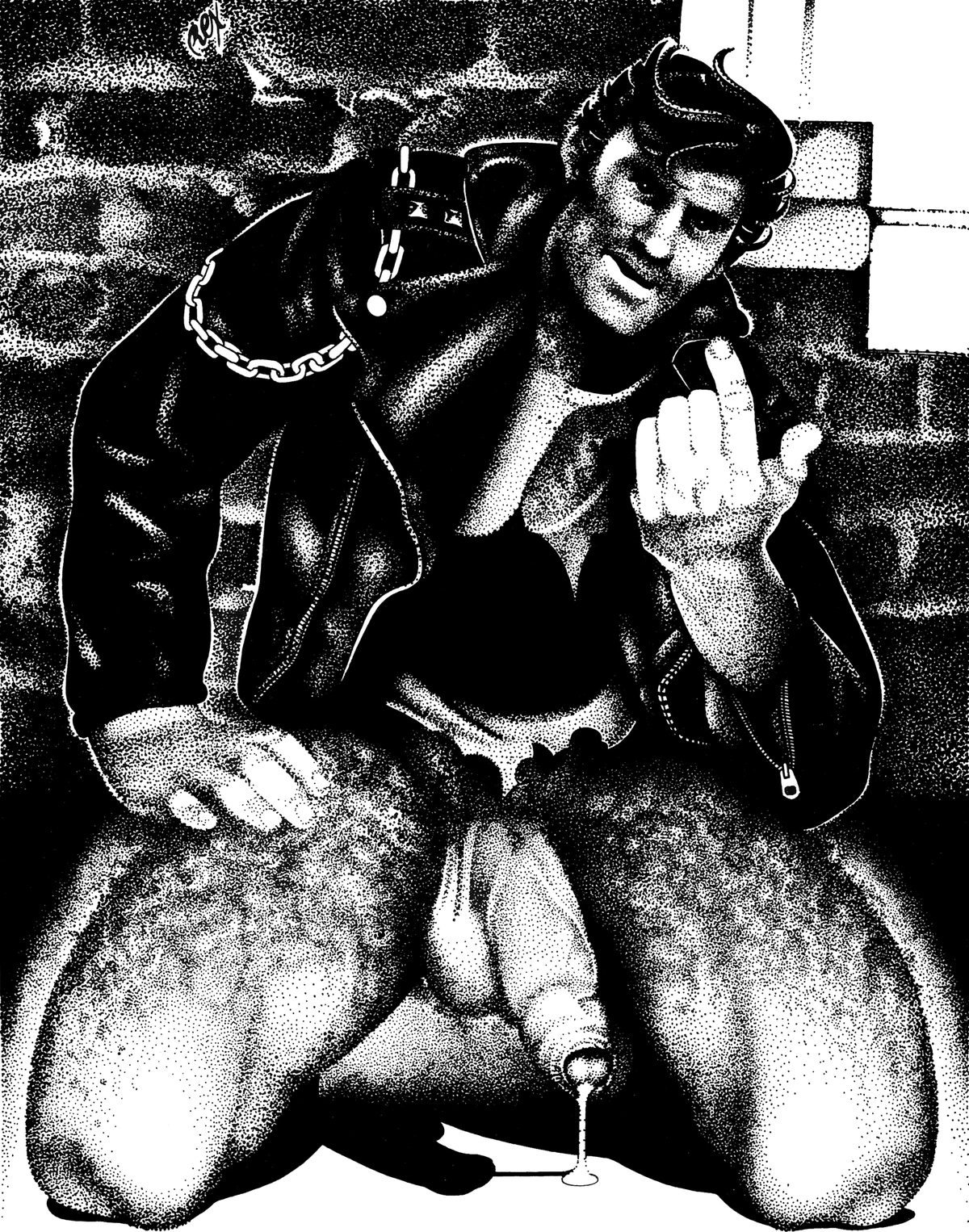
Take REX's 1983 drawing of a kneeling pantless leather-jacketed fellow with thighs spreading, cock dripping, and finger beckoning the viewer (fig. 17). Does anyone think that this example of hypermasculinity could pass for and enjoy the privileges of a straight man, not be taken as "queer" but as a man of the dominant and dominating culture—a General Haig or Colonel North figure? Obviously not. Although his heavy leather jacket might code to the objectionable, oppressive manners of, say, Hell's Angels, he could not, does not choose to try to, pass himself off as part of biker culture. For, his pose aside, the chain at his right shoulder says he wants it, wants it from a man, wants it hard from a big man. He is not someone running away from culture's hatred of gays by first embracing manners and tropes from the dominant culture's arsenal of oppression and then enhancing the oppression by making its tropes sexy. A REX man wants to have sex with hypermasculine men—men like himself.
Frequently, the iconography of gay male dress will blend and crisscross masculine images that, if taken severally, might suggest domination but, when taken collectively, undercut each other, so that no one could suppose that they draw for their charge on an identification of the gay wearer with the dominant culture. Take, for example, Tom of Finland's 1976 hitchhiker (fig. 18). He is nearly naked, yet he is studded all over with diverse signifying adornments. His leather hot pants and popper cartridge code directly to gay culture. But the rest of the outfit is a panoply of accoutrements from various traditionally male trades: a pirate's earring, a biker's tattoo, a gladiator's cuff, a policeman's cuffs, a cowboy's hankie, and engineers' boots. Another such configuration might include the distinctive apparel and signs of soldiers, sailors, aces, punks, lumberjacks, hardhats, roustabouts, truckers, carnies, and stevedores. Yet, clearly, no one would think that in reality our hitchhiker occupied any one of these coded roles: policemen do not wear earrings, and gladiators went extinct before motorbikes were invented. The figure is probably (socially speaking) a lowly barback in a gay bar: his tattoo reads "Tom's Saloon." Here, the masculine is eroticized, but not in a way that affirms the oppressive features of traditional masculine roles. The various roles' iconographies undermine each other. In pinning these uniformly gendered but clashing images on himself, the fellow cannot plausibly be taken to assume the privileges of any—not even one—of the roles to which his adopted postures allude. Indeed, the hitchhiker's total presentational package exposes the stud to the charge "faggot." Far from endowing him with privilege, his public hypermasculine posture exposes him to violence.
Stereotypes are here used homeopathically. The hitchhiker's motley outfit enacts a creative adorational playfulness, a playfulness with a serious message, one threatening to some people. It says: "I sniff, fuck
the pyramidal structure of the whole drawing. And though the leftmost arm, graphically the most dominant feature of the drawing, would at first appear to belong to the large fellow on the right, it is really too long and sprouts from the wrong shoulder for that to be the case, or at least exclusively the case. Rather, drawn twice, the left-most arm can be seen in cubistic displacement as (also) belonging to the guy on the left, who then, as one would expect in affectionate erotic embrace, reaches to and controls the crotch of the figure on the right, who is presenting his genitals to that very end. An electron cloud of lines forming the ambiguous placement of arms and shoulders obliterates into mutuality any trace of dominance and submission and wraps the two men in the cosmos and privacy. Here we have equality achieved not through bland similarity but through a diffusing working back through the structures of domination and submission.
A more blunt working through of oppressive roles can be seen in the work of REX. Consider a gloryhole scenario (fig. 24). Its stud hero is laden with images of masculine dominance—leather jacket, Stanley Kowalski T-shirt, boot socks, jockstrap, and well-cured raunch. Yet he has taken the middle of three booths linked with gloryholes. This post, together with his seated position, is the typical posture taken by those seeking insertee roles in washroom sex. The surface geography of the scene would have him be the cocksucker of common parlance and give him the passive, submissive, "womanly" role of common thinking. Yet, twisting roles again, here, as at many a gay blowjob site, it is the sucker who is in control calling the shots. He attends in the first instance to his own pleasures, not giving in to the demands of his hole-piercing boothmates, not assuming a self-conception as servicer of and for others, a conception that would diminish his own agency. Indeed, in his studly "passivity" he has even induced desire for him as agent in the manhandler on the right, while putting the cool on the assertive guy on the left, whose posture—stiff dick wholly pressed through hole and twitching in open air—is difficult to maintain for any length of time unattended. The gloryhole neutralizes the insertor as dominator. There is cocksucking, but no facefucking, in traditional gloryhole sex. Thus, the geography of the gloryhole site, with its occluding of the traditionally active posture of the penetrator, allows our stud, despite his glazedover mind and intense oral fixation, to maintain a comprehensive sense of his own agency and to see himself completely on a par with those who would seek his services. Here, tropes of domination are taken up and reinscribed into a whole that asserts equality of persons. Raunch and sleaze—solvents of hierarchy—are two of life's great equalizers.
Or take a two-frame sequence of a Tom of Finland trio on a fence (figs. 25, 26). Two men are simultaneously fucking a third in the ass. This logistically tricky scenario is a gay fantasy more thought about than enacted. Its fantasy appeal for the gay fucker is that, while fucking, he is also stimulated by that which chiefly defines the object of his desire, the male signifier, the cock. It is a hypermasculine enhancing of the masculine with the masculine.
Still, the image is fraught with two possible heterosexual associations—the double fuck and gang rape—that might, in an objectionable way, provide some of the image's high charge. The double fuck—one cock in her cunt, another in her ass—is a staple of heterosexual pornography. But unlike the scenario of Tom's trio, in the double fuck the two fuckers do not touch each other sexually; the thin membrane between their cocks provides miles of ideological distance between them and homosexuality. Socially, they can reach each other in ideological safety only through or across the woman. In the double fuck, the woman is totally possessed, compressed, sandwiched, and immobilized between the men penetrating her. They bond with each other by bonding against her, like unfriendly nations drawn together by a common enemy.
By contrast, in the Tom of Finland sequence, the third person, the fuckee, is in the open. In his squatting position, he controls the fucking. He is not "topped," and, indeed, as we learn from the second frame, which shows the fuckee's orgasm, his pleasure comes first—ecstasy for everybody, but especially the fuckee. And, surprise, as we also learn in the second frame, far from being an aggressor or some counterpart to an assailant, the backward-leaning fucker is in bondage. Indeed, that his wrists are bound to the fence rail is what makes the topologically tricky act possible in the first place. The gay trio represents a building
like the Paraclete, life giving. The asexual reproduction of the Good Friday Spell is taken up into the human sphere: Lohengrin is a product of parthenogenesis.
Only gay-dreading discourses that view vaginal birth as the only normatively acceptable, because natural, mode of reproduction take such fantasies of male asexual celibate or male homosexual reproduction as unhealthy attempts, in the words of Elaine Showalter, to "evade heterosexuality altogether" and to "reject natural paternity for fantastic versions of fatherhood" and so take the fantasies as insults to women because not only denatured but also denaturing avoidances of them. Showalter presses even further and views such fantasies of male selfcreation as contagious diseases that spread "with a particular virulence in the 1880's." (Parsifal was penned in 1881.) She supposes that the fantasies represent an "envy of the feminine aspects of generation." They could, however, simply be the result of gay men wanting to have children—no envy involved at all. The difference here between the fantastic and the actual is now simply technology, the magic of the modern.
And what of the boys and young men of Parsifal? I do not know whether—actually I doubt that—the gay eroticist REX has ever heard of Parsifal; but one of his densest and, no doubt to some, most disturbing drawings, one of a tattooing scene (fig. 34), offers perhaps the best interpretation of the opera, which has puzzled into interpretative gridlock a century's worth of mainstream readings. The drawing shows how the developmental masculinist hierarchies of Parsifal would appear once they pass through the double motion of idealizing sublation and erotic desublimation. A whelp replaces Parsifal's dove, as a sign of the masculine world's harmony with the natural order when that order is respectfully adapted by man. The Grail boys who present Parsifal with a vessel full of male bodily fluids are replaced by a youth who ceremoniously holds, at frame's dead center, a full spent condom—the millennial chalice. The instrument of transubstantiation, the Spear of the Crucifixion, becomes a cock, which itself is undergoing transubstantiation, changing from a natural object into an artwork, into a tattoo, a matrix of dots, like the picture itself. The boy and the dog are our hero's
Richard D. Mohr, Gay Ideas: Outing and Other Controversies, Beacon Press, Boston, 1992
Gilreath uses MacKinnon and Dworkin's anti-pornography framework to critique gay male pornography and, specifically, Richard Mohr's defense of REX's art in Gay Ideas. On REX's 1983 drawing (fig. 17, "Come a Little Closer"):
"Like virtually every defender of pornography, Professor Mohr asks us not to see what is apparent. He takes as an example of the transgressive potential of the hypermasculine a 1983 pornographic drawing by REX. In the drawing, 'a kneeling, pantless, leather-jacketed' muscle man, thighs spread around a semi-erect, large, and dripping erection, beckons to the viewer. In analyzing the photo, Mohr suggests that the obvious tropes of dominance described don't mean what they obviously mean."
"But the exclusion of 'feminine' or non-hypermasculine men from this erotics is a politics: it is a patriarchal, misogynist politics. It tells us who matters, who is seen, and who is invisible."
Shannon Gilreath, 35 L. & INEQUALITY 289 (2017).
Early critical attack labeling REX's homoerotic leather imagery as fascist aesthetics, reflecting mainstream discomfort with the intersection of masculinity, sexuality, and power in pre-AIDS gay culture.
Critical Writing
In the backroom, the basement, the blackened booths at the 'bookstore,' and the blind alley at 3 a.m.—light, darkness and shadow mix and mingle, reflect and retreat, like a flickering projector playing film noir. This is no place for children, or debutantes, or high-class ladies in search of the next Jackson Pollock. If you find an art critic here, he's not going to give you his real name or say where he works. In this place without business suites, where criminals, vampires and man-eating beasts go to feed, danger mixes with excitement, and risk finds its reward. This is the underworld landscape in which REX draws his sustenance and sups his inspiration.
The headline read "Controversy Disrupts Mayor's Art Gala," and opening the San Francisco Chronicle, late in the afternoon in 1985, REX had no reason to read any further. He did not need to attend the event to know who they were talking about, or guess what might have happened. When he received the letter from the Mayor's office, congratulating him for being selected as one of San Francisco's 100 Most Influential Artists, he knew down to his core, that it was not going to end well. If REX had a middle name, it would begin with a C, because 'controversy' has followed him most of his life.
The piece in question, "DOORBEATS," is not included in this collection. The subject matter remains the purview of the plain brown envelope that follows the signed statement of consent. In the three months it took him to create the work—dot by dot, millimeter by millimeter, he never imagined that it would grace the walls of a gallery, or sit in the spotlight of a studio or salon, or even eventually end up here, catalogued in this coffee-table book. His meticulous, almost obsessive construction of this well-regarded piece of pornography without penetration was intended to be appreciated in a toilet, or pinned to a wall of a shed where a man goes when he needs ten minutes alone with his thoughts and his left hand, or hidden under the mattress in that same plain brown envelope it came in, now spotted with human stains.
The "art world" has always had its Rembrandts, Warhols, and Jasper Johns who create art solely in hope of financial success and public adoration, and there are those who refuse to believe any artist would shun media recognition, because they would rather be spending through the soiled streets of the Tenderloin with Old Reliable's deviant director David Hurles or waxing philosophic with a Maddog tattooist like the queer artist Robert Sobrey. They might even point to the iconic commercial work that REX has done for New York's notorious MINESHAFT and L.U.R.E. or San Francisco's seminal Taste of Leather and LONESTAR Saloon as evidence of corporate corruption, because they do not know his story or understand how these "public works" afford him the time to focus on his own visions in private.
The gay writers and journalists who have sought to interview him often share the same specific questions about his early years, the crucial points in his youth and development that turned his inimitable technical genius to such sleazy and sordid subject matter. "If they only knew..." he likes to say, followed almost immediately by, "and don't you dare tell them."
He knows that the details of his early years would read like a gay Cinderella story—more suited to self-loathing pulp fiction—an almost magical fantasy that could only overshadow the misery and isolation that spawned it. His is the story of the socially isolated American farm boy who fled the narrow-minded persecution of his small Northeast home town to live on the streets and in the flophouses of New York City in the 1950s, the era of the beatniks. Not far from the Greyhound bus station, where he first arrived, technically a few years short of the age of consent, he was discovered by a famous effete fashion designer who brought him home to his Manhattan penthouse. After two years paying for art school, his gentlemen friend whisked him away to Paris to launch his career as a "child prodigy" of illustration and design in the most notable fashion and travel magazines of those times.
REX knows that gay biographers want to hear about "what it was like" to be surrounded by the world's most renowned fashion designers, artists, models, publishers, ballet dancers and diplomats who shared a secret language in a time before "Gay Culture" had
When these same would-be historians want to know about "how much he loved Gay Paree in the 1950s," they have little interest in hearing how he learned to loath artifice—the sad way style overshadows substance or how attitude trumps ability over and over again.
Most biographers do not want to hear about his fondest memories of his times in London and Paris—the 'cottages,' the t-rooms, the public pissoirs, temples conceived and existing solely to bring relief to the male member, not distinguishing between straight or gay, and unconcerned with superficial divisions like color or religion, or how old or young, how pretty or ugly, how rich or poor the cock is. Before there were hook-up sites, or bars, or even bathhouses, men have always gathered together indoors and outdoors, in places like that, to pull out their meat and let nature take its course. He knows that it is only his devotees who are really interested in the distasteful truth.
REX prefers that his life story began after he fled the crushing confinement of luxury and fortune and rediscovered his independence once again on the streets of New York during the early 1960s. When people want to know about his inspirations and how he got his big break in publishing, he tells a far grittier tale.
In a magazine shop on 8th Street between Greenwich Village and St. Mark's Place, just beyond the curtain that separated the unread copies of LIFE, Popular Mechanics, and Ladies Home Journal from the shop's actual trade, REX discovered his true calling. In the rows and rows of shelves containing black and white photo magazines, pulp novels with scurrilous titles, and collections of bound drawings, he first encountered Tom of Finland, not the man, but a pirated collection of his 'dirty little drawings,' and like so many men of his generation, his life was irrevocably changed by what he saw.
For the generations that have grown up with gay characters on television and in the movies, who can find 'man on man'
magazines in street corner kiosks and national bookstore chains, or more hardcore action available in both local video shops and online on demand, it is difficult to remember that in the USA in the 1960s both homosexuality and pornography were illegal. Though many in the LGBT community want to give credit to the birth of America's gay consciousness to the drag queens and rebels at the Stonewall Tavern, New York City's criminal underworld had long known that the number of men who loved men was far greater than the general population recognized, and gladly provided this invisible subculture with images and activities deemed dangerous and 'socially corrosive' by vice squads, state courts and the population at large.
Where inquisitive academics of the time with a broad liberal arts backgrounds could find gay role models hidden in history, from Aristotle to Alexander, William of Orange to Walt Whitman or Oscar Wilde, the average man on the street was offered only examples of the suicidal or the psychotic homosexual in the popular press and movie media, lumping all gay men together with Leopold and Loeb, child dressers. Tom of Finland's images of strong, healthy, happy men hav ing sex with men, passionately and enthusiastically, without remorse or regret, was an earth-shaking discovery for many men, including REX.
As a sexually active youth who had been "kept" for more than three years, who had tricks in three countries and two languages, REX was by no means naive in the ways of the world, yet these unapologetic images spoke to him in a way no lover or anonymous stranger ever had. Never in his brief stint at the Art academy or the endless walking tours through museums of Europe had he been as physically or emotionally moved as he was by the small, poorly printed portfolio of pencil drawings most likely reproduced without the artist's knowledge or consent. Tom's shameless bravery and graphic honesty inspired REX in a way that his first love, Caravaggio, never had.
Six months later, he returned to the shop where he'd first encountered Tom's work, and cautiously and carefully showed his own early erotic artistic experiments to the shop's clerk, sitting behind the counter, and much to his pleasure and surprise, received a wolf whistle and, after a quick phone call, the address of a man he should talk to about publishing his own first edition.
Every fiber in REX's young body told him to keep walking when he saw the four gentlemen on the concrete stairs in front of the old Brooklyn brownstone. He had been around long enough to know that these were not the type of men you say "hello" to without a previous introduction. Nonetheless, he swallowed his reason, walked up to the smartly dressed Italian quarter and half whispered, half mumbled, that he was "there to see Nick," before quickly offering the name of the guy from the magazine shop who had sent him.
Instead of the bullying he anticipated, one of the four looked him up and down, gave him the slightest smile, and offered to show him the way. Walking up the darkened interior staircase, the only sound the boy who would be REX recalls was the pounding in his chest and his ears, and the overwhelming sense that he would never come back down those stairs again, and in many ways, he never did.
Entering an unnumbered door without knocking, he passed through the front room unnoticed by the seven old men and women, dressed almost entirely in black, who yelled and argued with each other in Italian as a radio played. They did knock when they reached the door in the back, and after a startlingly loud "Gimme a Minute!", a young woman with messed up hair opened the door, buttoning her blouse and exiting so they could enter.
Although it had looked like an apartment building from the outside, REX was as surprised to see the vast warehouse of boxes, as he was to see the man behind the desk, smoking the butt of a thick cigar in a stained tank top undershirt. After his escort offered only the briefest of introductions, "Dirty Nick" told our young hero, "Come're Kid, show me what you got."
Instead of unzipping his pants, as he thought the man sitting in his striped boxer shorts expected, the as yet unnamed REX offered up his portfolio instead. And for the second time in his very short pornographic career, REX heard a wolf whistle, followed by the words "My God, boy, we're gonna make you the next Tom of Finland."
He knew down to his very core that there was only one Tom of Finland, and he was only following the master's lead. Nonetheless, the smell of sweat, cigar and dried semen overwhelmed the youngster's senses. "Dirty Nick" would be REX's employer and mentor for the next ten years of his life.
"First thing we gotta do is come up with a name for you. Bob of Brooklyn? Nigel of New York?" Looking at the obscene cover of an 8mm film on the gangster's cluttered desktop, the boy offered its title as a suggestion, and from that day on, one of the most brilliant pointillists of the 20th century has been known to the world solely as "REX."
The New York City of the 21st century bears little, if any resemblance to REX's New York of the 1960s and 70s. The criminal underworld that brought millions to Time Square and 42nd Street has been replaced by the criminal overlords who bring billions to Wall Street before quickly shipping it off to Switzerland and the Cayman Islands. The once notorious "Meatpacking District" is now the home of Manhattan's premier fashion designers and high-end supper-clubs and gastro-pubs.
Although REX had learned many lessons in brutality, honor and the importance of never naming names in his time as courier, shop clerk, and boxing club manager for the Mafia, the experiences that formed the foundation of his artwork and his understanding of true brotherhood began in October 1970, when he first entered the blue-collar biker bar on 11th Avenue called THE EAGLE. To call this place a 'leather bar' would evoke certain contemporary notions and presuppositions that did not exist at that time. The men there dressed like motorcyclists because they actually rode motorcycles, and a black leather jacket was earned, not pulled off the rack at some highend fetish fashion boutique.
The men of the original EAGLE shared two common elements that appear and repeat themselves over and over again throughout REX's life work. Here he encountered the unaffected men he had first met in the public toilets of Paris and London—World War II, Korean War, and Vietnam Veterans, mixed together with dock workers, merchant marines, journey men, burnt-out athletes, defrocked priests and the would-be Satanists that the horny holy men often unintentionally created. In retrospect, we could easily say that they were there because they were all "gay", that this was the secret language they shared, but that would be incorrect—this was NOT a disco, or a drag bar, or a beatnik poetry club.
The men of THE EAGLE'S NEST came to their sexual awareness in the world of men, not through intellectual or socio-political discourse, but through camaraderie and ritual, in institutions separated from the social, economic or moral constraints of the "feminine." Though many of the men in the bar at the time were married to women—that was a separate world, a societal obligation, not a personal choice that many enjoy today. The blue collar biker bar and the motorcycle clubhouses were places where men could be men—unapologetically—where a dude could enjoy a blowjob without having to give anyone $20 or a wedding ring. This was a world where no one was offended by a burp, or a fart, or a grappling on a pool table. Before the era of the fashion-forward pageant crowd, these places where for men who worked with their hands, who fought and fucked without fear of retribution or arrest, and who were never embarrassed by the dirt under their fingernails.
Like the under-groomed, uninhibited, all-natural workingman, dirt is the second key component in REX's world. In their company, the artist learned the importance "dirt" plays in masculine sexual imagery. He firmly believes that as a masculine "prop", dirt and grease can do for a man what makeup does for a woman. The unwashed look of the men in his drawings resulted directly from coming to terms with the role dirt of many types plays in underpinning a man's sex appeal; either with or without it. His devotees frequently tell him..."hmm, I can smell your men."
Because he had a talent they wanted, REX achieved a certain acceptance in the periphery of the world of organized crime with relative ease, yet the crowd at THE EAGLE was not as immediately welcoming. He did not own a motorcycle, he was not a veteran, and though he had seen more blood and bullet holes than the average enlisted man, the most significant condition of his day-job was his respect for and adherence to "the code of silence." So initially, he watched the ritual and raw ravagings from the sidelines, studying the men and the artistry with which they embraced and broke the laws of nature. In this brave new world, these leather clad industrial studs practiced and perfected acts only alluded to, and often inadequately referenced, in the pocket book porno-stories that he had recently begun to illustrate.
Only after a short-order cook that he had been stalking saw him working on a sketch and recognized his style from the pages of the ROUGH TRADE series, one of the first hard-core series of illustrated sex novels, was he asked to make a portrait, and then help with the covers for one of the biker club's mimeographed newsletters. Soon after, he earned his leather jacket and found himself invited on road rallies and to initiation parties, where he began to transition from the role of observer to that of full-fledged participant in bizarre yet fully consensual acts, most often described in psychological manuals, exploitative pulp fiction and police reports of the time.
When he began working as the House Artist for New York's notorious MINESHAFT in 1976, his technique took a dramatic turn, moving from the realm of imaginative illustration into the world of unquestionable art. Like many soldiers who return from the battlefield with a distinct and undeniable hatred for firearms, REX's time with the Mafia showed him first-hand the clear differ ence between sex and violence, and though both play significant roles in male fantasy in the Western world, REX's work became focused on hard and aggressive play, not the over-romanticizing of force, violence or victimization. His time spent at THE EAGLE helped him understand that true male sexuality is not a byproduct of reason or "political correctness"—many men enjoy the most filthy and depraved avenues of sex for psychological or subconscious reasons unique to each individual. And in fact, sometimes the more unacceptable or forbidden the act in the eyes of moralists, the most tantalizing and titillating it becomes.
Intentionally located in the Meatpacking district below 14th Street in Green wich Village, in hopes of encouraging 'limp-wristed' tourist and spoiled Uptown elitists who "wouldn't be caught dead in a place like that," the building vanished in light of day. Its proximity to the Hudson River tunnels and bridges provided easy access for redneck bikers and average working Joes who frequently snuck in from New Jersey for deviant fun away from the wife and kids. Amid ancient derelict slaughterhouses and packing plants, along the dirty streets and stinking doorways, deserted by sundown, an unmarked fire-engine red metal door on Washington Street, lead to the entrance of THE MINESHAFT. Visitors were greeted outside by a biker in full leather who checked membership cards or IDs. THE MINESHAFT limited its dress code to leather and Levis, and no one in suits, sneakers or casual wear was allowed in. The most contentious rule being that no artificial "scents" such as deodorants or perfumes were allowed on any man who entered. The slightest whiff of anything pretty or vaginal meant instant rejection. Many men were turned away nightly, but those that got in constituted the hottest group of men gathered together in one place that REX had ever seen, before or since. The place was marked by its smell and dress code, but as the era of political correctness kicked in, these rules became the subject of heated debate.
The bar's owner, a 'hard ass' named Wally, had come to the big city to study theater and work on Broadway, but soon found his calling far from the Great White Way, in the gritty underworld of sexual theatrics. What on the surface looked like an abandoned warehouse was in fact carefully orchestrated sleaze, mapped out by the owner down to the slightest detail. The place became famous for its low sinister lighting—unique at that time, but much emulated since—inviting sex at every turn. Wally brought in theatrical experts to design the lighting scheme that prevailed throughout the two story building, creating pockets of illumination, intended specifically to enhance every sexual "scene," from pin-lights over slings to nearly pitch black spots in the glory hole booths, set with a single spot focused solely on the point of revelation.
It was at THE MINESHAFT that REX first became aware of how important "lighting" is to both great sex and in portraying sex in a two dimensional medium. Before he started "living" at THE MINESHAFT, the lighting in his drawings can seem flat with his focus on the action itself. The more he studied nightly the effect lighting had in contributing to the sexual magic of the place, the more attention he began to pay to the lighting in his own drawings. His focus shifted from black dots on white paper to bright figures emerging from shadow and darkness.
By that time REX had published two portfolios of his own, MANOEUVERS and ICONS, and was quickly becoming known as one of the hot young gay artists in New York. Gay celebrities from all over the world visited THE MINESHAFT, politicians and political scumbags, Pulitzer Prize and National Book Award recipients, Tony and Academy Award winners, along with a well-known billionaire investment tycoon with a magazine named for himself, fucked with and beside longshoremen, dock workers, plumbers and electricians. Porn stars, rock stars, and world-class escorts met with some famous "Factory" artist, and his physique model, turned escort, turned junkie avant-garde film star/traveling companion.
Before it closed in November 1985—another victim of AIDS and the hysteria and chaos that surrounded the epidemic in the United States—REX finished three posters for the club, which in turn were reproduced on thousands of T-shirts and tank tops which tourists purchased as souvenirs of their pilgrimage to THE MINESHAFT, spreading his images worldwide for the first time in his adult life.
For REX, the Great Folsom Fire of 1981 foreshadowed the death of gay men's culture in America. Every original piece of REX's artwork that was not in the hands of private collectors or publishers burned over the course of ten hours along with three city blocks in the heart of San Francisco's South of Market.
In the decade that followed, REX watched as the plague spread like the flames that devoured his drawings, taking away his friends, lovers, tricks and admirers—strong, vibrant rebels removed from the world, one by one, like some sinister plot, while most American politicians said nothing, and so many religious leaders in the United States gloated over the suffering of undesirables.
The USA of the 1990s, the editorial staff of DRUMMER Magazine adopted the same restrictive guidelines as the rest of America's mainstream soft-core mass market publications of the time, imposing aesthetic rather than informed biological understanding and responsibility—no ejaculation, no urination, no perspiration, no smoking, and no touching, and as any fan of REX's knows, these are but a few of his favorite things. He was told instead, that his artwork might be considered if he focused his illustrative genius on smooth, CLEAN, single-figure drawings of wholesome youths between the ages of 18 and 32, preferably wearing the latest male leather lingerie. Where many consistently employed erotic artists of his time were financially forced to "tone it down," REX simply said "Fuck You" and retired.
When the opportunity to move to Europe once again presented itself in the late winter of 2010, he immediately leapt at the chance to preserve both his legacy and his sanity. Relocating to Amsterdam early in the spring of 2011, the old master feels like he is home once again. After twenty long years, sales and commissions were ten times as great as anything offered before his self-imposed exile.
Artists, interviewers, and fans, both old and new, still regularly ask, "When can I meet REX?" And the answer is quite simple. If you have ever knelt down in front of a glory hole and found yourself truly amazed and physically inspired by what came poking through that hole, then there is a very good chance that you have already met him.
Bo Tobin Anacabe, "Back Room," in REX Verboten!, Bruno Gmünder Verlag, Berlin, 2012
Local Archive
The following materials are preserved in the REX Pagan Art archive:
- Bay Area Reporter article photograph (1991)
- New Yorker Magazine review — Hudson Gallery exhibition (1998)
- Jack Fritscher — "Rex Bible Project" article text
- Jack Fritscher — "On Rex" essay text
- Blogspot feature on REX
- Antwerp exhibition photographs (8 images)
- Complete bibliography — publications 1972–2022, exhibitions 1994–2021